Strengthening Sepsis Awareness, Early Detection and Treatment in Mozambique and Across Sub-Saharan Africa
The Mozambique team of the Sub-Saharan Africa Consortium for the Advancement of Innovative Research and Care in Sepsis (STAIRS) joined the global community in commemorating World Sepsis Day 2026, observed annually on 13 September, through a series of awareness-raising and scientific engagement activities aimed at improving the prevention, early recognition and treatment of sepsis.
In collaboration with the Instituto Nacional de Saúde (INS) Mozambique, the team organized an educational webinar and developed two informative infographics to increase public understanding of sepsis, highlight its significant public health burden and encourage timely medical intervention.
These activities represent important milestones in the Mozambique STAIRS team’s ongoing commitment to advancing sepsis research, strengthening healthcare capacity and promoting evidence-informed approaches to improving patient outcomes.
Advancing Scientific Dialogue Through a World Sepsis Day Webinar
As part of the commemoration, the Instituto Nacional de Saúde hosted a webinar on 14 September 2026, under the theme: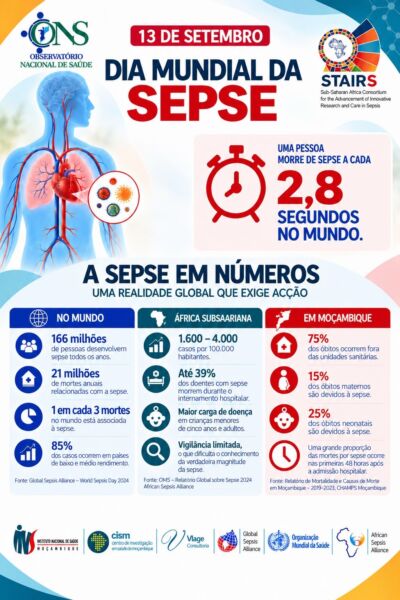
“World Sepsis Day: Together for a Timely and Effective Response.”
Conducted virtually through Microsoft Teams, the webinar brought together researchers, medical practitioners and healthcare professionals, including physicians from major healthcare facilities across Mozambique.
The discussions focused on the challenges associated with sepsis prevention, early detection and effective treatment, while highlighting opportunities to strengthen healthcare responses at national and regional levels.
Expert Presentations and Discussions
The webinar featured presentations from healthcare and research professionals with expertise in infectious diseases, public health and sepsis management.
Dr. Virginia Lara Evaristo delivered a presentation titled “Detection and Treatment of Sepsis: Challenges for a Timely and Effective Response.”
Her presentation addressed critical challenges in recognizing and managing sepsis, emphasizing the importance of early identification, timely clinical intervention and effective healthcare responses.
Dr. Celso Monjane presented on “The Burden of Sepsis Globally, Regionally, and in Mozambique: Impact and Public Health Priorities.”
His presentation highlighted the burden of sepsis across different geographical contexts, drawing attention to its implications for public health and the need to prioritize prevention, surveillance and improved clinical management.
The webinar was moderated by Dr. Ivalda Macicame, a Research Physician at the Instituto Nacional de Saúde and Principal Investigator of the multicenter STAIRS project in Mozambique.
Through these presentations and discussions, the webinar helped inform stakeholders about sepsis and stimulated interest in greater collaboration to address the condition.
Raising Public Awareness Through Educational Infographics
Recognizing the importance of accessible health information, the Mozambique STAIRS team also developed and disseminated two educational infographics in Portuguese to support public awareness and understanding of sepsis.
The materials were designed to communicate essential information about the condition, its global and regional burden, warning signs and preventive measures.
Infographic 1: Sepsis in Numbers – Understanding the Global and Regional Burden
The first infographic, titled “A Sepse em Números” (Sepsis in Numbers), highlights the substantial burden of sepsis worldwide, with particular attention to Sub-Saharan Africa and Mozambique.
Drawing on global and regional sepsis reports, the infographic presents key statistics illustrating the scale of the public health challenge.
It highlights estimates of approximately 166 million sepsis cases and 21 million sepsis-related deaths annually worldwide, as reported in the campaign material. It also draws attention to the disproportionate burden experienced by low- and middle-income countries.
For Sub-Saharan Africa, the infographic highlights reported sepsis incidence ranging from 1,600 to 4,000 cases per 100,000 inhabitants, alongside challenges associated with hospital mortality, disease surveillance and limited availability of reliable data.
In Mozambique, the material emphasizes the contribution of sepsis to maternal and neonatal mortality, as well as the importance of strengthening early recognition and timely healthcare interventions.
These statistics reinforce the need for sustained investment in sepsis research, surveillance, prevention and improved access to quality healthcare.
Infographic 2: Recognizing Sepsis and Taking Action
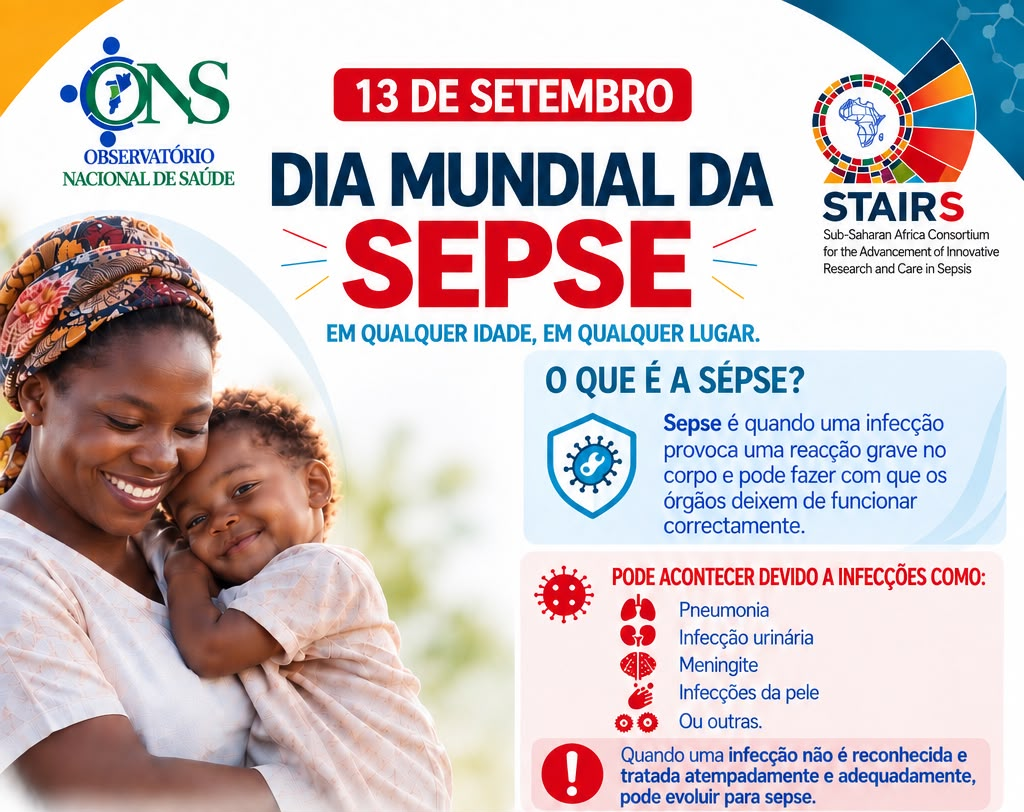
The second infographic, developed under the theme “Sepsis at Any Age, Anywhere,” focuses on improving public understanding of sepsis, recognizing warning signs and promoting preventive action.
It explains that sepsis is a life-threatening condition that occurs when the body’s response to an infection causes organ dysfunction.
The infographic highlights infections that may lead to sepsis, including pneumonia, urinary tract infections, meningitis and skin infections.
It also outlines important warning signs, such as:
- Fever or abnormally low body temperature.
- Rapid breathing or difficulty breathing.
- Confusion, altered mental status or unusual drowsiness.
- Increased heart rate.
- Low blood pressure.
- Extreme weakness or a feeling of faintness.
The material emphasizes the importance of seeking immediate medical attention when sepsis is suspected, as early recognition and appropriate treatment are essential to improving survival.
In addition, it promotes preventive measures, including vaccination, proper hand hygiene, appropriate antibiotic use, timely healthcare-seeking and additional protection for vulnerable populations.
Together, the two infographics provide valuable educational resources for healthcare professionals, community members and other stakeholders involved in sepsis prevention and management.
Strengthening Collaboration and Public Health Engagement
The World Sepsis Day activities provided an opportunity for the Mozambique STAIRS team to engage healthcare professionals, researchers and the wider public in discussions about one of the most pressing challenges affecting healthcare systems.
By combining scientific dialogue with accessible public health communication, the team contributed to greater awareness of the importance of preventing infections, recognizing sepsis early and ensuring timely and appropriate treatment.
The webinar also encouraged professional engagement and collaboration, supporting broader efforts to improve knowledge and strengthen responses to sepsis in Mozambique.
These activities reflect the value of coordinated research, capacity building and knowledge-sharing initiatives in addressing sepsis across Sub-Saharan Africa.
A Significant Milestone for STAIRS Mozambique
The successful organization of the World Sepsis Day webinar and dissemination of educational infographics mark important milestones in the Mozambique STAIRS team’s awareness and stakeholder engagement activities.
Through continued collaboration with national health institutions, researchers, healthcare professionals and international partners, STAIRS seeks to contribute to innovative approaches that strengthen sepsis research and care.
The Mozambique team’s participation in World Sepsis Day 2026 demonstrates its commitment to advancing knowledge, promoting early diagnosis and supporting improved clinical responses to sepsis.
Together, through research, awareness, collaboration and timely action, we can strengthen the response to sepsis and help save lives.
Related Resources
World Sepsis Day 2026 Webinar
Theme: Together for a Timely and Effective Response
Date: 14 September 2026
Format: Virtual – Microsoft Teams
Organized by: Instituto Nacional de Saúde, Mozambique
Awareness Materials
- Infographic 1: Sepsis in Numbers – A Global Reality That Demands Action.
- Infographic 2: World Sepsis Day – Understanding Sepsis, Recognizing Warning Signs and Prevention.
The awareness materials were developed and disseminated as part of the Mozambique STAIRS team’s World Sepsis Day 2026 commemoration activities.